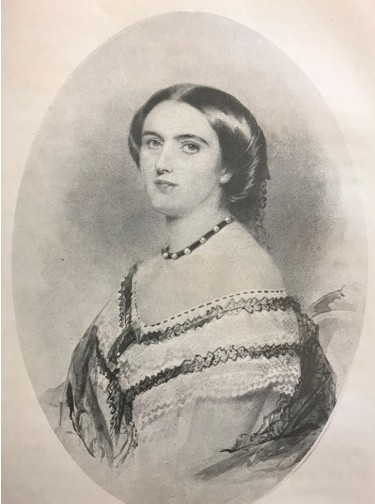
 Marie Blaze de Bury (1813 - January 27, 1894) was a Scottish-born French political writer, novelist, critic, and salonnière.
Queer Places:
18 Rue du Cherche-Midi, 75006 Paris
Cimetière du Montparnasse, Paris, Département de Paris, Île-de-France, France
Marie Blaze de Bury (1813 - January 27, 1894) was a Scottish-born French political writer, novelist, critic, and salonnière.
Born Marie Pauline Rose Stuart (or Stewart) Menteath in Oban, Scotland, around 1813, her exact lineage was surrounded by mystery; while raised under the guardianship of an army officer named William Stuart, rumors of her parentage persisted throughout her life—most notably that she was the illegitimate daughter of the prominent British statesman Lord Henry Brougham.
At age nine, she was sent to France for her education, laying the foundation for her fluid, trilingual literary career in English, French, and German.
Blaze de Bury became a formidable figure in 19th-century European intellectual life:
To navigate the male-dominated literary market, she published under masculine pseudonyms, including Hamilton Murray (notably for her 1848 Parisian novel Mildred Vernon) and Arthur Dudley.
Fiercely anti-Bonapartist, she vigorously opposed the regime of Napoleon III. Her works frequently engaged with contemporary geopolitics, such as her 1851 travel commentary Travel to Austria, Hungary and Germany During the Events of 1848 and 1849.
She contributed regularly to major periodicals, including Revue des Deux Mondes, Blackwood’s Magazine, and the Daily News. In Paris, she hosted an influential political and literary salon that brought together prominent European intellectuals, diplomats, and writers.
In 1844, she married the French musicologist, critic, and librettist Henri Blaze de Bury (1813–1888).
She died in Paris in January 1894, remembered in obituaries as a exceptionally sharp political analyst and cultural commentator.
During the late 1880s and 1890s, the acclaimed American Southern author Grace Elizabeth King and her sister Annie "Nan" King undertook extended sojourns across Europe. In Paris, they formed a deep personal, literary, and domestic attachment to Baroness Blaze de Bury.
Whenever the King sisters resided in Paris, they frequently lived directly with Marie Blaze de Bury in her apartment.
Blaze de Bury served as a mentor and gateway for Grace King, introducing her to elite French literary circles, publisher networks, and cultural salons.
Their archive of letters reveals an affectionate, highly intimate bond characterized by mutual emotional reliance, shared household duties during travel, and sustained care during illness.
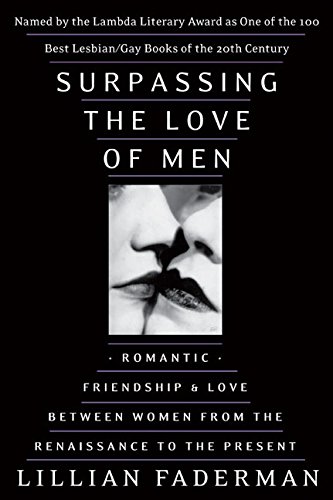
While 19th-century figures rarely used modern identity labels like "lesbian" or "bisexual," the ties between Marie Blaze de Bury, Grace King, and their contemporary social circles are significant within queer history and women's romantic friendship studies:
In 19th-century literary culture, deep, emotionally passionate, and often cohabitating relationships between women were common and socially recognized under concepts like romantic friendships or "Boston marriages." Grace King remained unmarried throughout her life, choosing instead to structure her emotional and creative world entirely around women—her sister Nan, figures like writer Annie Adams Fields, and Baroness Blaze de Bury.
By opening her Parisian home to Grace and Nan King, Blaze de Bury helped create an autonomous, female-centered sanctuary that operated outside conventional patriarchal family structures. For women writers of the era, these living arrangements provided both the emotional intimacy and professional freedom necessary to pursue independent literary careers.
Blaze de Bury moved comfortably through cosmopolitan circles that blurred standard gender and sexual norms of the Victorian era:
She adopted male personas to write freely about state politics.
Her intimate circle encompassed non-conforming female intellectuals across Europe and North America who prioritized female solidarity, cohabitation, and lifelong emotional devotion over traditional marital expectations.
Frances “Fanny” Mary Blackett—later known to her contemporaries as Madame du Quaire—was an English salonnière and prominent expatriate figure in Anglo-French Victorian social circles. Surviving manuscript letters preserved at the Morgan Library & Museum showcase a close, lively correspondence between Fanny Blackett and Baroness Marie Blaze de Bury during the 1850s. As an unmarried woman in her early thirties dependent on her brother (MP John Fenwick Burgoyne Blackett), Fanny wrote candidly to Marie about the social and economic constraints imposed on unmarried women. In her letters, she sought advice on visiting Paris independently and recounted her efforts to champion cultural figures (such as pianist Ernst Haberbier) across London and Parisian salons. Following her marriage to a Frenchman and subsequent widowhood, Fanny became widely celebrated for her independent, non-conformist lifestyle and expansive network of literary friends, including Robert Browning and Elizabeth Barrett Browning, Matthew Arnold, Henry James, and Marc-André Raffalovich. Like Marie Blaze de Bury's relationships with Grace and Nan King, her connection with Fanny Blackett reflects Marie's role at the hub of an international network of independent, culturally active women navigating 19th-century homosocial spaces and social autonomy.
References:
Other references:
Support this project
This website is a passion project researched, developed, and funded entirely by me. If you find the content valuable and would like to help support the ongoing research and hosting costs, any contribution is deeply appreciated.
Thank you for keeping this independent resource alive!
My books on Amazon: Elisa Rolle's books